First working version
Text-to-Book, from 3CX straight into Mews
A guest texts one of your property lines. The enquiry is read, the details are pulled out, and the reservation is written into Mews — with nobody at a desk keying it in. Anything the guest left out goes to whoever is on duty instead of becoming a missed booking.
Built as a demo on example enquiries. Nothing is connected to a live Mews or 3CX account yet.
The shape of it
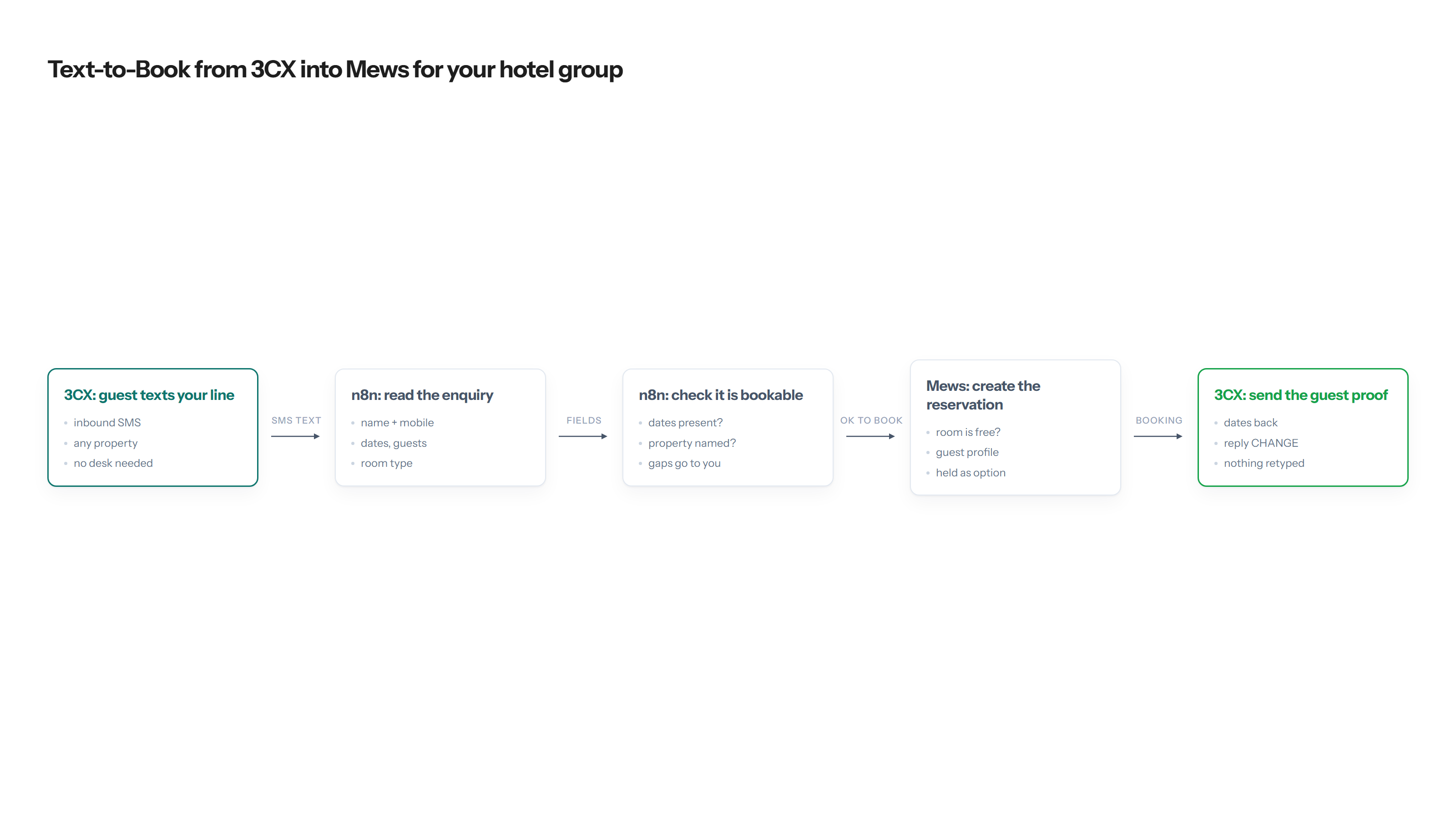
Five stages, left to right. Everything between the first box and the last happens without a person touching it.
What a real enquiry looks like going through
A guest writes the way guests write — no form, no fields, no order to it. These are the details the automation pulls out of that message.
What the guest texted
What goes into Mews
- Guest
- Marcus Whitfield
- Property
- Noosa Heads
- Arrival
- 2027-03-06
- Departure
- 2027-03-09
- Nights
- 3
- Guests
- 2 adults, 1 child
- Room
- King
- Note
- Late arrival ~9pm
Stage by stage
Each of these is one step you can open, read and change later. Nothing is hidden inside a black box.
The text arrives from 3CX
3CX posts the message, the guest's mobile and the property line it came in on. One entry point covers every property in the group, so there is nothing to set up per hotel beyond the number.
3CXThe enquiry gets read
The message is read for a name, a property, arrival and departure dates, how many adults and children, and the room type. Dates written as "the 6th to the 9th" or "next Friday for two nights" come out as real dates in Australian time. Nothing is guessed — anything the guest did not say comes back empty rather than invented.
AI reading stepThe details are squared up
The mobile number 3CX gave us is trusted over anything typed in the message, the name is split into first and last for the Mews guest profile, and the length of stay is worked out from the two dates. A booking of zero nights, or one that runs backwards, is caught here.
n8nIs there enough to book?
A reservation needs a name, a property and two valid dates. If all four are there, it goes through. If anything is missing, the enquiry stops and a message goes to the duty manager saying exactly which pieces are absent and what the guest actually wrote — so a half-finished enquiry never becomes a wrong booking.
n8nMews gets the reservation
Availability is checked for those dates at that property, then the reservation is created with the guest profile attached and the original text kept in the notes. It is written as an option rather than a confirmed stay, so the team still has the final say when they are back at a screen.
Mews Connector APIThe guest gets it in writing
A text goes back over 3CX repeating the property, the dates, the nights and the guest count, with an invitation to reply CHANGE if any of it is wrong. The guest has proof within a minute, and a mistake surfaces while it is still cheap to fix.
3CX
Two things worth deciding early
Mews or SiteMinder
This version writes into Mews, because a reservation belongs in the PMS. The same two steps can point at SiteMinder instead, or at both — SiteMinder for distribution, Mews for the stay itself. Only those steps change; everything in front of them stays as it is.
How far it should go on its own
Right now a booking lands as an option and waits for a human to confirm. It can be set to confirm outright, or to hold only above a certain number of nights, or to always pause for the multi-room enquiries. That is a policy choice rather than a technical one.
Files
The diagram as an image and as an editable file, plus the workflow itself.